TECHNOLOGY
Motor Faults & The ALL-TEST
PRO
|
|
Based on statistical data compiled by the Electric Power Research Institute (EPRI), 47% of motor failures are due to electrical faults/failures. The 47% can be further broken down into rotor problems (10%) and winding problems (37%). Mechanical faults may sometimes have root causes that are electrical in nature.
Winding defects can occur due to insulation age, contamination, power surges, thermal overload, damaged wire/materials, vibration, and other causes. They begin as energy crossing an insulation fault (such as moisture or contamination), which isolates at least one turn. This generates additional stress and heat across the defect, which progresses until an arc is drawn and the winding fails.
|
Motor
Circuit Analysis
|
> Click here for MCA overview
|
About
Winding Faults
|
|
There are four basic types of winding faults.

- Between turns in a coil
- Between coils in a phase
- Between coils in different phases
- Between a coil or phase and ground
Only about 5% of electrical faults begin as a fault to ground. The other three fault types may or may not propagate into a ground fault as the failure becomes advanced. The short-term result of these faults is reduced efficiency (and higher operating costs). Symptoms include higher operating temperatures, perhaps nuisance tripping, and reduced motor life. As faults advance, power and torque may decrease. The longer-term result is always motor failure.
Megohm Insulation testing will detect only faults to ground. In that only 5% of faults begin as ground faults, the majority of faults will go undetected using this method alone. Surge testing requires the application of high voltages and currents, and can be a destructive test, actually generating faults. This aspect, combined with the size of surge testing equipment makes it inappropriate for troubleshooting and predictive maintenance testing, especially on larger motors.
Download PDF File: Winding Analysis Theory.
*You will need Acrobat Reader to download PDF files. Click Here for latest Acrobat Reader Version.
|
ALL-TEST™ Measurement
Technology
|
| In
a healthy 3-phase motor, the windings are electrically balanced. These
balanced electrical characteristics include passive properties, such as
resistance, and active properties, such as inductive reactance and impedance.
As faults develop, one or more of these electrical properties will change,
depending on the type and magnitude of the fault.
ALL-TEST™ instruments are unique in that they perform a series of
impedance-based tests (inductance, phase angle, impedance, and a current
/ frequency ratio) on each winding. These measurements and their balance
across the three phases provide a clear picture of the condition of the
motor circuit. This test and analysis method will quickly indicate the
presence of a fault, even at its earliest stages. The tests are preformed
at low AC voltages, so there is no stress to the windings.
ALL-TEST™ methods are static measurements, meaning that they are
made on un-energized motors. In this regard, they are useful not
only for predictive maintenance activities, but also for checking new,
recently repaired, or failed motors.
The ALL-TEST™ instruments are effective in testing all types of
motors: three-phase, single-phase, and DC. Even traction motors and
machine tool servos can be effectively tested without removal or disassembly.
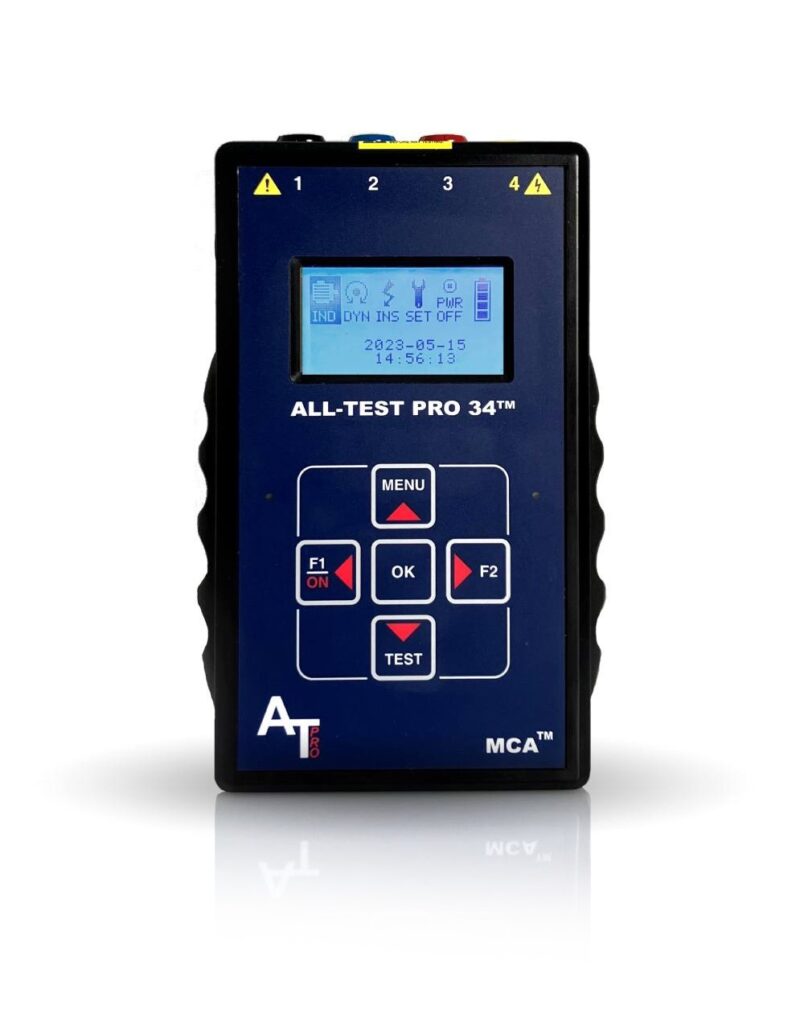
A knowledgeable operator, using our ALL-TEST IV PRO 2000 analyzer
along with our companion software can accurately diagnose virtually any
electrical fault in any size motor, coil, or winding!
|
|